Forest Pursuits
Almost all the high ground of Forest Hill and Sydenham was covered in woodland at the time John Rocque was publishing his map, in 1746. Of course, by that date many of the mature trees in the wood had been felled to provide timber for house-building in general and, in particular, ship-building at Deptford. Nevertheless, the general scene must have been a rural one and very much a feeling of being in the countryside.
By the 1700s Sydenham was an emerging village. Forest Hill was yet to be named and, apart from the possible farm house, there were no dwellings there at all. Over the hill (Sydenham Hill), on the London side, lay Dulwich Village. It seems so natural to refer to it as 'Dulwich Village' when, in fact, it was technically a hamlet because there was no parish church until St Barnabas was built 1892-95 in Calton Avenue. North of One Tree lay a few houses at Nunhead and a larger community at Peckham.
Due south was the hamlet of Penge and, to its east, was the village of Beckenham. On the eastern side of Sydenham was the tiny hamlet of Sydenham Green - now better known as Bell Green (or worse still Sainsbury's !) and to its east was another hamlet called Southend (now better known as Homebase !). Until 2011 a pub called the Green Man (see picture) stood beside the main road at Southend which had a name very much associated with 'all things green'.
It may be worth pointing out that today's Grove Tavern, now in use as a Harvester pub and restaurant, standing at the junction of Dulwich Common with Lordship Lane was previously known as the 'Green Man' from its earliest reference in about 1690. It was not until much later that the present name was used.
None of the place names just mentioned had much more than a hundred or so residents to that the total population in and around the area probably only numbered one thousand or a little bit more.
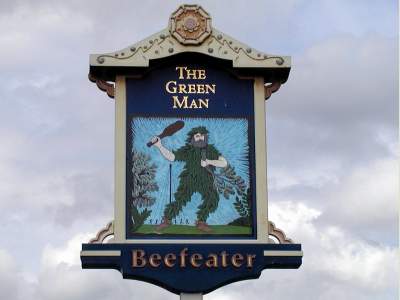
The Green Man sign which stood outside the pub opposite Southend pond until it was demolished in 2011
In these times, the canal and railways were unheard of and farming pursuits were the only form of employment. WIth the higher ground being mainly wooded, it was the lower ground, around what are now Forest Hill and Sydenham stations, that could be farmed with crops. The much lower land, around Sydenham Green (now Bell Green) and going north to Catford was pasture, lying either side of the tiny stream still known as the River Poole.
Along with forestry and farming, this diverse countryside was an ideal place for wild animals to live. Foxes must have lived in the vicinity, as they still do today. Another animal that was often seen was the deer, now confined to Outer London in these modern times. Hunting, therefore, became a favoured past-time of the wealthy and it is known that there sere several hunts organised across the land.
Evidence of hunting and similar sports in the area is sparse but a few clues remain around today for which details are to be listed below.
Fox and Hounds, Kirkdale
This pub name reminds us of the very essence of hunting. The pub stands on the corner of Wells Park Road, where it joins wih Kirkdale. Sadly, about 2011 the name was abbreviated to 'Foxy's', probably in a bid to sound more trendy, and it to be hoped that the original name will be restored one day.
While it may be hard to imagine a fox being pursued across open fields and through woodland undergrowth amid all the buildings we see around us, hunts were known to meet and cross land around Sydenham.
As a pub name, it probably only dates from the 18th century since, in earlier times, fox-hunting was considered an inferior sport to hunting animals like deer.
This pub name is one of several in Inner London. One is not far away - at New Cross. Another similar name is 'Fox on the Hill' a pub standing on Denmark Hill, in nearby Camberwell.
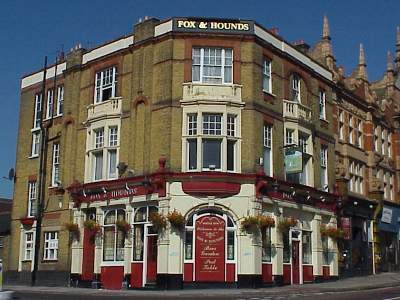
The pub stands at the junction of Wells Park Road with Kirkdale.
Greyhound Inn
There has been a 'Greyhound' pub in Sydenham for about 300 years. Its site is shown on John Rocque's map of 1746. It was quite a large, elegant building. Those with very long memories may rember that it once had two life-size figures of greyhound dogs positioned either side of the main doorway.
The 'Greyhound' is now a shadow of its former self. The pub closed and the considerable land around the site was re-developed in housing. After a campaign to save the pub, the developers agreed not to knock it down but little remains of the original building that many of us remember fondly.
On the other side of Sydenham Hill is Dulwich where there is another large pub by the same name. There are no less than 20 pubs with this name in Inner London.
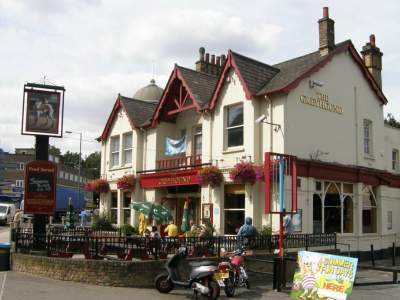
The Greyhound Inn, Sydenham, in August 2007 shortly before it closed
Bird in Hand, Dartmouth Road
As a pub name in Inner London this is one of six similar ones.It would be great to see the picture of a falcon or similar bird depicted on the pub sign, reminding the visitor of how the name arose. Sadly, the pub has no pub sign on it at all.
The pub claims to have been in existence in the days when the Croydon Canal ran along the bottom of its garden which would be around the 1820s. Whether that is true is not known but it would be a suitable date for falconry in the vicinity.
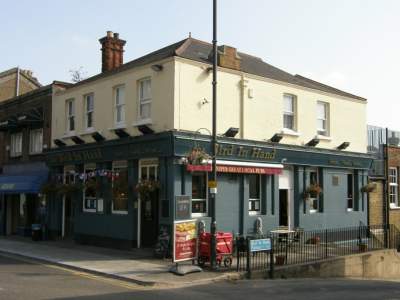
Bird in Hand pub, Dartmouth Road
Hill House, Honor Oak Road
There is one remaining house in Forest Hill which claims to have been used as a hunting lodge. It stands at 64 Honor Oak Road, near the steep junction with Westwood Park.
It was probably built about 1796 and further extended over the following two decades. The elegant Georgian building has every indication that it was used as a hunting lodge.
There is a tradition that it was used as a royal hunting lodge by William IV and later by the Duke of Clarence but that story has never been proved.
The imposing doorway opens dangerously near the roadway. Around the corner from the doorway (far left of the picture) is a charming 'old world' garden leading to a side entrance to the house.
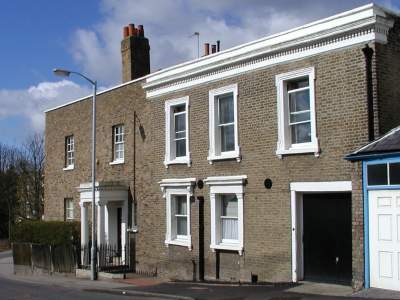
Hill House, 64 Honor Oak Road