Forest Hill and Sydenham
Forest Hill and Sydenham are situated at the southern end of the London Borough of Lewisham. The most well-known landmark is Crystal Palace Television Transmitter (see image) which can be seen right across London. It lies just outside the boundary of the two areas, just within the London Borough of Bromley.
As the name implies, Forest Hill is an area with several hills with residents who live on top of them enjoying some of the finest views anywhere in London.
Going back in time, most of the land was covered by a dense forest,
called the Great North Wood. Over the centuries the trees were cut down
although both areas remain remarkably leafy even today.
Forest Hill and Sydenham are situated on and around an extensive ridge of hills. In Forest HIll, notable high points are One Tree Hill, the humped hill crossed by Canonbie Road and, thirdly, the hill crossed by Horniman Drive and partly covered by Horniman Gardens. Sydenham is situated on a long slope, rising from low ground at Bell Green, leveling off around Sydenham Station before rising again via Westwood Hill and Kirkdale to join different parts of a road known as Sydenham Hill. That road is almost level for most of its length, running along the top of a long ridge. It is still quite leafy. At one time the Great North Wood covered almost all the land.
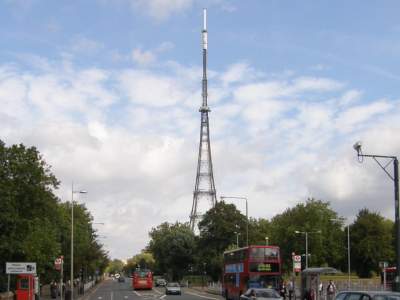
Looking along Crystal Palace Parade at the Crystal Palace Transmitter
A few Georgian houses are to be seen in the area, indicating that people have enjoyed living there even in the 18th century. The main wave of residential properties came after Crystal Palace was moved to Sydenham Hill in the mid-1850s.
There are plenty of
attractive Edwardian properties still remaining, often in well-situated
leafy streets. in the 1930s much of the farm-land was sold off for large
expanses of semi-detached houses. After the Second World War came the
inevitable blocks of flats on the housing estates, with the result today
that the area has very mixed adchitecture.
The Extent of the Two Areas
Forest Hill, as a place name, is not very old. The earliest reference to the name was in the 1790s. The name applied to a group of large houses, which are still to be seen, gathered around the T-junction of Westwood Park and Honor Oak Road.
Today, the name 'Forest Hill' covers quite a large area of land. It was given the Postcode SE23 in the 1920s. That boundary extends north to the boundary with Brockley, where Stondon Park joins onto Brockley Road; east to the little park called Blythe Hill and the road called Perry Hill; south to include Dacres Road and half of Dartmouth Road; west to part of the road called Sydenham Hill and the long road called Wood Vale; and NW as far as the little park called One Tree Hill.
Until 1900, Forest Hill was divided by the Surrey-Kent boundary, running through land now covered by Horniman Gardens. Most of Forest Hill was in the County of Kent, with a small part lying in Surrey.
Sydenham
was first mentioned in the 14th century. As a community,
Sydenham is therefore much older than Forest Hill. The centre of the
village of Sydenham was around
the junction of Sydenham Road with Trewsbury Road (see map), with
further houses dotted along Sydenham Road. The centre today would
probably be described as being around Sydenham Station.
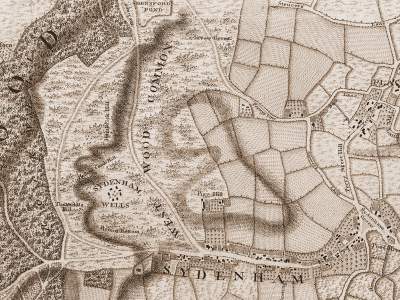
Forest Hill (top centre) and Sydenham (along the bottom) shown on Rocque's map of 1746
The area, now defined by the Postcode SE26, lies to the south of Forest Hill, extending just south of Sydenham Road where it meets the boundary with today's London Borough of Bromley. On its NW side, Sydenham (or more accurately Upper Sydenham) shares its boundary with the London Borough of Southwark.
Although Crystal
Palace Park, Crystal Palace Parade and adjacent Penge are just outside
the areas being described, they are too close not to deserve the
occasional mention in these pages.
An Outline History
The areas are not famous for great events in history but there are plenty of interesting events that took place. We cannot claim that Shakespeare was born here it was known to the diarist John Evelyn. There was no palace here but there are connections with royalty. It did not have a major Roman settlement on the land but it was crossed by a Roman road.
In its own humble way there is planty of local history in both areas which not only relates to the immediate localities but also relates to the 'bigger picture' of the history of London. We will take a look at some of the more important dates which give a brief chronology of the area.
AD 100 - a Roman Road ran from the Old Kent Road (a more famous Roman road) to Lewes, via Keston. Its line crossed Blythe Hill.
AD 957 - The Great North Wood (see image) was described in the Anglo Saxon Charter as being 'wood pasture'. It was also mentioned in 1086 in the Domesday Book. It was a large forest extending along a SW to NE axis, from Crodon all the way to New Cross.
1309 - Sydenham was first mentioned by name.
1606 - Attempts to enclose Sydenham Common led to the longest legal trial in the history of the Courts in England.
1640 - Sydenham Wells were first 'discovered'. They are now covered by Sydenham Wells Park.
1746 - Still mainly woodland, the areas of Forest Hill and Sydenham are shown on the first large scale map of what we now refer to as Greater London. Known as 'John Rocque's Small Scale Map of London' it shows the land of Forest Hill as just uninhabited woodland. The name of Sydenham appears on the map along what is now Sydenham Road.
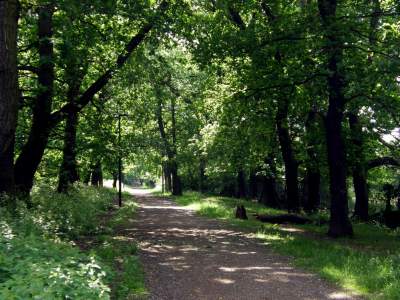
Cox's Walk, in nearby Dolwich. It is one of the few emnants of the Great North Wood
1790 - The first mention of Forest Hill by name. It referred to a group of houses established beside today's Honor Oak Road.
1801 - The Croydon Canal opened, running from near today's New Cross Gate Station to where West Croydon Station is now situated. Part of the route ran through Honor Oak, Forest Hill, Sydenham and then southwards through Penge.
1839 - The London and Croydon Railway opened, using the approximate route of the old Croydon Canal.
1854 - The Crystal Palace
opened after being taken down in Hyde Park and rebuilt on what was
originally known as 'Sydenham Hill'. The whole structure was almost
totally destroyed by fire in 1936.