The Forest
The entire area of Forest Hill and Sydenham was part of a far large piece of land covered by the Great North Wood. This swathe of dense forest was north of Croydon and is why Norwood - in the form of South Norwood and West Norwood - is so-named. Forest is a feature of high ground and, with so many hills in the area, the woodland extended with a long narrow outline from where the hills start to rise, just NE of Croydon, in a diagonal SW to NE direction across today's Crystal Palace, Forest Hill, Sydenham, Honor Oak, parts of Brockley and ending at today's Telegraph Hill, near New Cross.
The densely wooded, hilly terrain affected how the area developed. The image on the right was taken in Dulwich Wood, which lies near the Southwark side of the road called Sydenham Hill. Although it cannot claim to be within the area being discussed, it is only a short distance away and it probably gives some idea of how much of the land must have looked up to the 16th century. In many places much of the woodland was still in evidence until Victorian times when the development into streets and housing estates saw the rapid decline of the rich woodland that covered Sydenham Hill.
Looking at John Rocque's map, published in 1746, it is evident that the Great North Wood was a natural barrier to roads. Only tracks are to be seen on the map. Due to the many trees and, of course the steep hills, it was quite unsuitable for carts to travel across the land. Even today there are few roads crossing Crystal Palace Parade and Sydenham Hill, causing traffic jams at
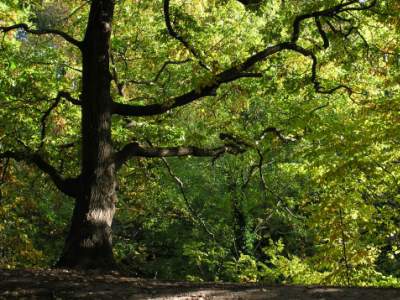
A view of Dulwich Wood, one of the few remaining parts of the ancient Great North Wood
rush-hour. Today there are essentially two main roads - one known as Central Hill, Westow Hill and Anerley Hill, running across the southern end of Crystal Palace Parade and the other is London Road, better known as the South Circular Road, used by traffic travelling between Dulwich and Forest Hill.
Although much of Forest Hill and Sydenham are built over, with streets and houses, it is surprising how many large and beautiful trees still remain in the area. It would be reassuring to think that they remain from the original forest but that is not very likely. How they got there is not as important as the fact that they are still very much in evidence.
Early Communities
In Medieval times, few people lived in the Great North Wood by choice. Those who were living there, had occupations like forestry, timber-felling and charcoal-burning.If you live in a forest, there is little point building your house from bricks when you can use timber which is freely available. Today, we a fortunate enough to have a few examples of what we call 'weather-boarded' houses still remaining. The image shows a pair of houses, near the T-junction formed by Dartmouth Road with Kirkdale.
It is traditional for today's home-owners to paint their property in white, as these houses two are. In earlier times a woodman usually wanted to waterproof the exterior against the wet weather. Such houses, therefore, were usually black, covered by a thick coating of tar. There is an example of a 'black' covering at Pond Cottages, near the South Circular Road, in Dulwich.
As well as the houses shown here, there is another example in Mount Gardens, a cul-de-sac off the west side of Kirkdale, where a pair of similar small houses are to be seen.
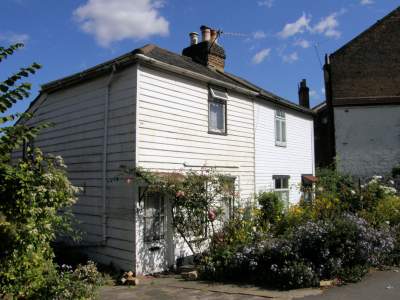
A pair of westher-borded houses near the T-junction formed by Dartmouth Road with Kirkdale
To complete the weather-boarding count of houses in the whole area, the side of a large Georgian house in Sydenham Road, near the junction with Newlands Park, has one side covered by boarding.
The Woodman
It is easy to take local names for granted, without thinking about what they mean. At the top of Dartmouth Road, where it joins with Kirkdale, is a pub still known as 'The Woodman'. Long may the name continue!
The pub name is no coincidence and relates to men who often lived in the forest for the years that were working. Being a woodman was a busy life. As well as managing the forest, there were trees to be felled for timber. In the case of this forest, which was rich in large oaks and elms, we know that many of those trees were cut down and taken to the wood-yards in Catford to be laid up and seasoned. They were later taken to the carpenter's shops at the Royal Naval Dockyard, at Deptford. They were sawn up and used to build the ships for the navys at the time of Henry VIII and his daughter Elizabeth I.
The woodland at Sydenham, therefore, has an important connection with Britain's history. Some of the ships built at Deptford were operating on the 'high seas', fighting against the Spanish Armada in 1588.
As well as 'The Woodman', there is another pub standing beside Sydenham Hill, near the junction with Wells Park Road, called 'Dulwich Wood House'.
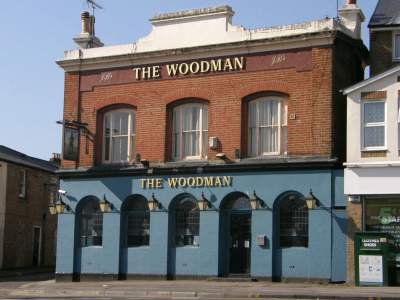
The Woodman stands in Kirkdale, just opposite the T-junction with Dartmouth Road
In Perry Vale, near Forest Hill Station is a pub that used to be called 'The Foresters Arms'. Sadly it has been renamed to the more mundane 'All Inn One'.
Charcoal Burning
Burning wood to make charcoal is a very ancient craft. A large quantity of wood was either laid out in an elongated mound or in the form of a cone. It was then covered with turf or just plain earth to keep out the air while the wood was burning. The wood inside the pile was set on fire and was burned in a controlled way so that the gases escaped from the pile but so that the wood was not consumed, becoming ashes.
The burning process could take take several days, sometimes a week or more. Until Stuart times, there was a great demand for charcoal in the City of London and Westminster. By then, demand outstripped the supply and many domestic hearths were heated by coal.
There is no direct evidence for this craft in the area and no streets carry names relating to this rural skill. While many people still use charcoal on their barbeques, none of it is sourced from this part of the world any more.